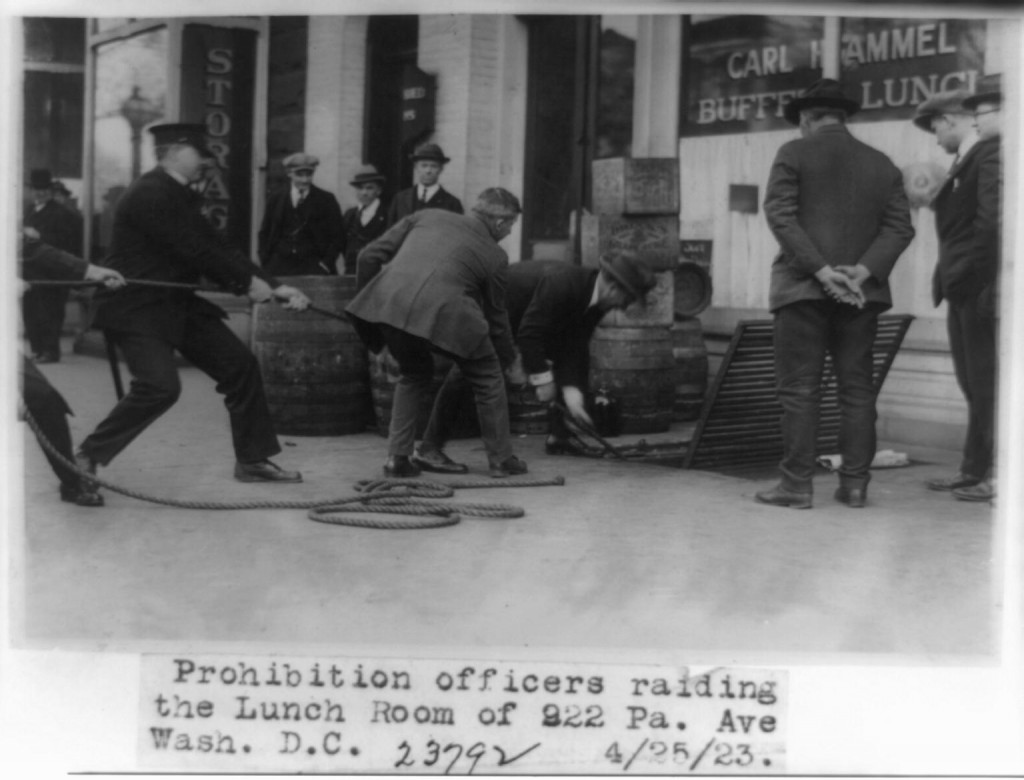
Today marks the 80th anniversary of the repeal of prohibition, the infamous time in American history where the whole country went "dry".
Prohibition was the result of years of cultural changes that occurred in the decades leading up to the 1920s. Increasing urban populations meant larger cities and more saloons, and many people felt that drinking was destroying families and homes. A surge of special interest groups arose to fight the cause. Dry organizations such as the
"Anti-Saloon League" and the "Women's Christian Temperance Union" made the push to ban alcohol, and in January 1919, the 18th Amendment was ratified. A year later, the amendment went into affect, banning the sale, transportation, and production of alcoholic beverages. The government and supporting citizens looked forward to what they thought would be a more morally sound America, with reduced instances of crime and a focus on religion and family. Unfortunately, hindsight is 20/20, and the amendment helped sent America into somewhat of a downward spiral economically and culturally.
The 18th Amendment had many unforeseen effects. Those previously in brewing or distilling industries were forced to find new forms of work, and farmers growing things like barley or cider apples had to start fresh with new crops. While it was predicted that the lack of bars and alcohol would stimulate the entertainment industry, places such as restaurants and movie theaters, there was actually a sharp decline. Restauranteurs found it hard to be profitable without the sale of liquor, and almost immediately after the nation went dry, there were underground efforts determined to reinstate "wet" culture. Bootlegging, the production and distribution of illegal alcohol, became an enormous industry. "Speakeasies", underground saloons that served bootlegged alcohol, became prolific, with estimates saying there were between
30,000 and 100,000 unofficial bars in New York City alone. These bars often required a password for entry, and many were closely associated with organized crime.
That, was perhaps the worst of the unforeseen consequences of the 18th Amendment. Due to the difficulties of enforcing prohibition laws, organized criminals, such as the notorious
Al Capone, seized the opportunity provided by prohibition and began running extensive illegal bootlegging, speakeasy and prostitution businesses. Organized crime exploded, and bootlegging gangsters gained a firm holding in larger cities. In smaller, rural areas, the laws were easier to enforce. However, in urban centers, such as San Francisco, New York and, the center of Capone's most infamous activities, Chicago, corruption among law enforcement as well as politicians meant the rules were much more relaxed. In either case, as time went on, bootleggers became more and more creative about their methods of production and distribution. "Moonshine" and "Bathtub gin" became speakeasy staples. These were illegally distilled spirits, and because they were not regulated, they were often quite dangerous. Some estimates say that up to
1000 Americans died annually during prohibition, from drinking badly made homemade liquors.
The corruption and organized crime that was spawned by prohibition meant that by the end of the 1920's, public support for prohibition was decreasing quickly. With the Great Depression hitting in the early 1930's, many sought the repeal of the 18th amendment, arguing that beverage production and sales would create jobs and stimulate the decimated economy. President Roosevelt, before his election, made prohibition repeal a focus of his campaign. Shortly after his election, in December 1933, the 21st amendment was ratified, ending federal prohibition. Local state and county laws remained in place for some time, with a
few state wide bans in effect through 1966. Today, some counties are still dry, and it is illegal to distill spirits in your home in any state, without a special federal permit.
Prohibition did succeed in lowering the drinking rate in America, for a short time. 80 years after the repeal of prohibition, and some laws of the era are still in place, including the regulations surrounding federal distilling permits. However, some good things did come out of the era. Moonshine and bathtub gin were usually so nasty to taste, that bartenders upped the creativity with cocktails, leading to what are still some of
America's favorite drinks, such as the Sidecar (not invented in America, but became extremely popular during prohibition) and the French 75, which is actually believed to have been a result of prohibition. Most notably, the 19th Amendment was passed in August of 1920, giving women across America the right to vote in elections. Who knows when that landmark event would have happened had the country not been (mostly) sober?
Source:
Wikipedia, History Channel,
Image Credit
 Tablebases.com
