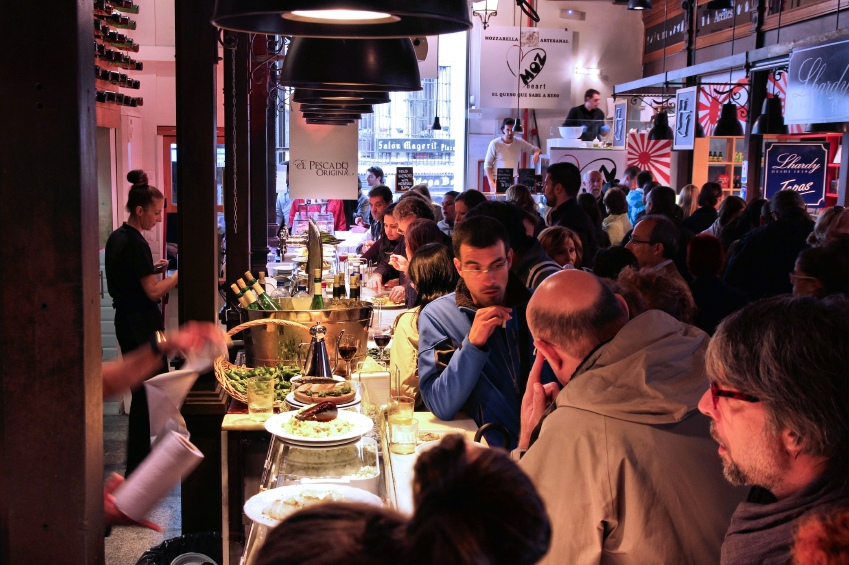
If you're someone who dines out, even infrequently, then you have probably experienced a noisy restaurant. Between the bartender mixing cocktails, pans clanging in the kitchen, background music and guests' conversations, the noise level can quickly become overwhelming. The situation can escalate, with everyone in the room speaking more and more loudly, fighting to be heard.
We've written previously about Comal, a Berkeley California restaurant that not only installed passive soundproofing materials, but also an active, electronic system to help reduce noise and reverberations in the space.
The Boston Globe recently launched an information investigation of the sound levels in a few New England restaurants, and came away with some interesting results, and reasons, for the raising levels.
Journalists at the
Globe picked eight restaurants in which to dine, and brought along a small SPL (sound pressure level, in decibels) meter to test the ambient noise levels in each establishment. The results were surprising, with the most quiet restaurant measuring
66 decibels, which is conversation level, and the loudest registering at
86 decibels, which is more akin to a large power tool. Sound experts note that subjecting your ears to high levels of sound (80+ decibels) can be damage your hearing, an especially big concern for staff who work in these environments.
There seems to be a trend in the restaurant world, skewing towards more lively, upbeat spaces for dining. Part of this, it seems, comes from changing times, with the
Globe noting that Millennials (restaurateurs best friends), prefer more communal, social, high-energy atmospheres. The
Globe quotes Robin Brown, former general manager of Four Seasons Hotel Boston, "People got bored with boring energy levels in restaurants so there's a general demand for more excitement and animation". Restaurateurs are focusing more and more on creating entertaining environments. As California restaurant owner
Jay Porter notes, "We'll do whatever we can to get you to have a better time, because success for us requires that we move beyond serving delicious food and into the business of creating compelling experiences".
To top it off, as the
Globe notes (we've also noticed this trend among the restaurant designers with whom we work), restaurant design has changed dramatically over the last several decades. Gone are the days of thick carpeting and cushy chairs;
wood, metal and concrete are the materials of the 21st century. Hard surfaces, big, uncovered windows and stone floors make for a great sight, but they also reflect sound, causing it to reverberate around a space. Restaurants such as
Comal retrofitted their space extensively to help
control sound without sacrificing their interior design goals, and owners of noisy restaurants should probably consider some solutions as well. As the
Globe notes, the 2014 Zagat Boston Restaurants Survey found that high levels of noise were the biggest complaint from customers, and the number one thing that deterred them from restaurants.
What do you think? Are loud, boisterous restaurants the way of the future or should we all tone it down a bit? Let us know what you think via Facebook, LinkedIn, Google+ and Twitter.
Source:
Boston Globe,
Image Credit (Flickr)
 Tablebases.com
